15 Feature Request Software Tools for Managing Product Feedback

By Dayana Mayfield
Last updated on Tue May 12 2026
The most successful SaaS companies aren’t just building—they’re listening. In today’s hyper-competitive market, customer-driven innovation is what sets leading software brands apart. According to Salesforce’s State of the Connected Customer report, 73% of customers expect companies to understand their unique needs and expectations.
Meanwhile, a HubSpot study found that 69% of consumers are more loyal to brands that actively seek and use their feedback. That’s why using a feature request software tool isn’t optional—it’s essential. These platforms help you collect ideas, prioritize feedback, and take meaningful action. Ready to better connect with your users and build what they actually want? Keep reading to learn what a feature request tool is and how to find the right one for your team.
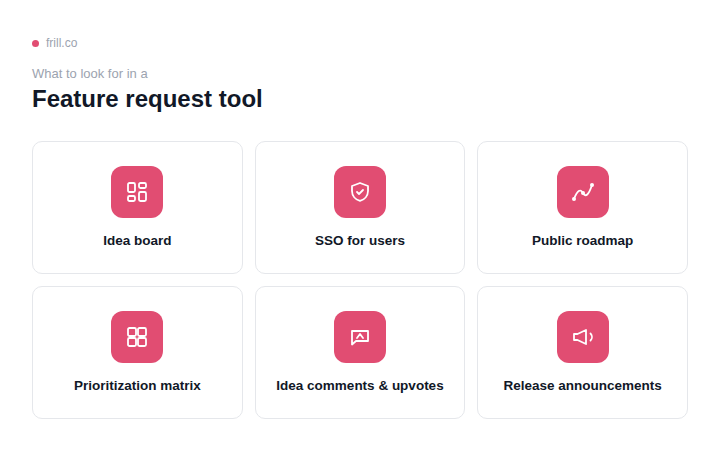
What should you look for in a feature request tool?
Since several feature request tools are available, finding the right one for your team can be tricky. Here are a few features to prioritize if you want a tool that can help you achieve your goals:
Easy-to-use idea board to collect feature requests in one place
Your users can use idea boards to suggest new ways to improve your product or service. Besides capturing ideas from users, the best idea boards have a voting system that allows users to upvote the best ideas. You can prioritize taking action on the most upvoted ideas.
SSO for users
Single sign-on (SSO) is an authentication tool that allows users to sign into various platforms with the same credentials. This way, users can sign into the feature request app using the same credentials for your software or platform (no need to make a separate account.) SSO is essential for increasing customer participation and collecting as many feedback requests as possible.
Public roadmap
You need a public roadmap that will keep users updated about the actions taken regarding their feature requests. Depending on the status of a feature request, you may tag it as Under Consideration, In Development, Shipped, or Unlikely to Build. Your feature request tool should allow you to set up your own tags and column names. At any time, users can check out your public roadmap and see which feature requests have been accepted and which are not a priority.
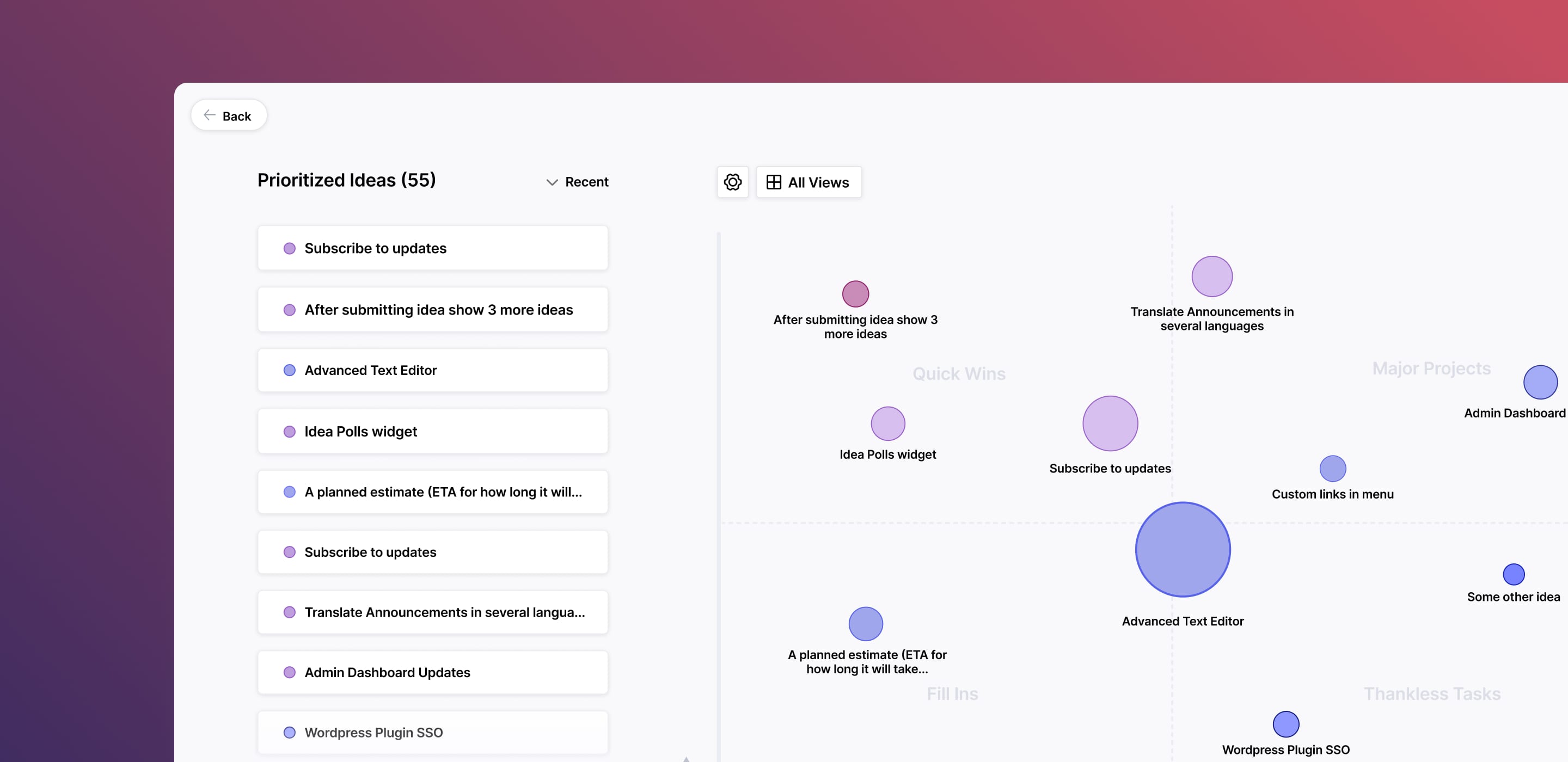
Feature request prioritization matrix
It's important to have a feature prioritization matrix that automatically helps you identify trends and common requests. The matrix pulls data from feature requests and shows you common terms and concepts. This makes it easy to prioritize what feedback to implement next.
Feature upvoting
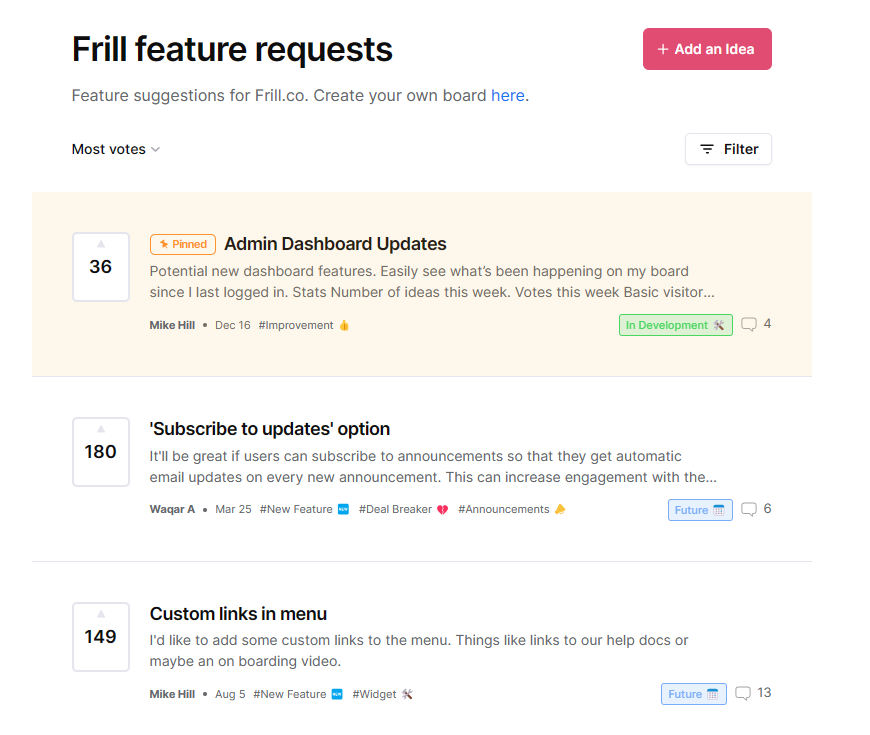
Upvoting is another important tool for prioritizing feedback. Users should be able to upvote each other's ideas so you can see which ideas are the most popular. The more upvotes you get, the more attention you should devote to that feature request.
Feature request comments
Comments are helpful for collecting deeper insights on a particular request. Your users should be able to comment on each other's feature requests so that you can get more qualitative data (beyond the quantitative data you get with upvotes). Users might voice their agreement or offer a different version or angle on someone else's idea.
Feature announcements (AKA changelog)
A feature request tool will be incomplete if you cannot notify users about newly launched features. The best feature request tools include a changelog feature so you can keep users informed of updates.
Feature request portal with custom branding and domain names
Your feature request portal should offer custom branding (colors, logo, etc.) and custom domain names so you can create a branded experience for your users. (Many platforms offer customization on higher cost plans, but Frill gives you access to branding and domain names on all plans, starting at $25 per month.)
Key integrations
You want a feature request platform that will integrate with other sources so you can automatically pull in requests from other channels. Look for a platform that offers all of the integrations you need for an affordable monthly subscription. (Many platforms only offer integrations on their Enterprise plans, but Frill gives you access to all 10 of our integrations on all plans, starting at $25 per month.)
Add feature requests on behalf of users
It's also nice to be able to add feature requests on behalf of users. This comes in handy when customers give you ideas during sales calls, customer success calls, or on social media or other platforms.
The role of feedback in product-led growth
In a product-led growth (PLG) model, success hinges on building features that users genuinely want. While analytics show what users are doing, feature requests reveal what they wish they could do. By embedding feature request collection into your product experience, you create a direct pipeline from user needs to product decisions.
Here’s how feature request tools specifically support PLG:
Capture demand for high-impact features: Feature requests help surface which ideas matter most to users, so your team can prioritize based on actual demand, not assumptions.
Turn power users into product co-creators: Inviting users to submit and vote on features builds a sense of ownership, encouraging them to invest more time and expand their usage.
Identify what’s missing from your onboarding experience: Repeated requests for features that already exist may indicate onboarding gaps—giving your team insights to improve education and discovery.
Reduce churn by acting on unmet needs: When customers leave, it’s often because the product doesn’t solve a big enough problem. Feature requests can flag must-have functionality before churn happens.
Showcase a customer-driven roadmap: A public roadmap tied to feature requests sends a clear signal: “We listen.” This transparency builds trust and keeps users engaged long-term.
For PLG teams, feature requests aren’t just noise—they’re guidance. Listening to them consistently helps you shape a product that retains users, earns loyalty, and grows through word of mouth.
15 feature request tools to consider
Now that you know what to look for in a feature request tool, let’s look at the top 15 tools on the market.
1. Savio
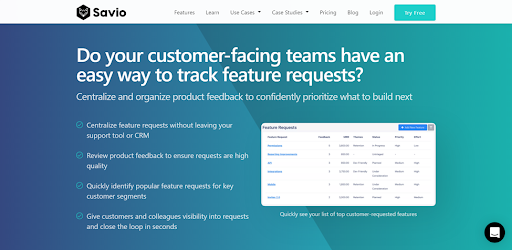
Savio is a user-friendly platform that facilitates collecting and tracking feature requests. The tool can also help you differentiate between high and low-quality product feedback and suggestions.
Top features
Slack, Zendesk, and Chrome integration
Feature prioritization
User feedback filter
Pros and cons
Savio offers all of the basic features you need for managing feature requests and improvement ideas. However, their lowest cost plan is $49 per month, and you can find cheaper alternatives.
Pricing
Savio’s pricing starts at $39/month for the Essential plan, which includes 1 paid user, unlimited free users, and core feedback features. Professional and Business plans at $79 and $249/month add advanced prioritization, integrations, and CRM support.
2. Sleekplan
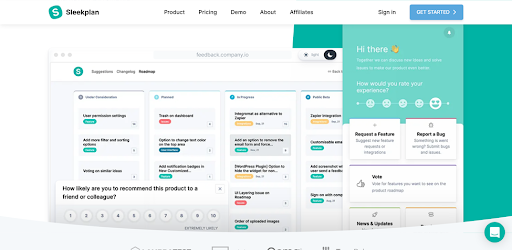
Sleekplan is a user feedback tool used by businesses in various industries. With Sleekplan, you can collect product feedback and feature requests via feedback boards, satisfaction surveys, and other means.
Top features
Roadmap and changelog
Feedback widgets and custom domains
Chrome and WordPress integration
Pros and cons
Sleekplan offers a robust free plan, making it a solid option. However, the platform is really lacking when it comes to integrations, making it difficult to keep all your feature requests in one place.
Pricing
Sleekplan offers a free Indie plan with unlimited feedback and users. Paid plans start at $13/month (Starter) with 3 team seats, and $38/month (Business) for 10 seats. All plans include feedback boards, changelogs, roadmaps, and NPS. Enterprise plans offer custom pricing and unlimited team members.
3. Frill
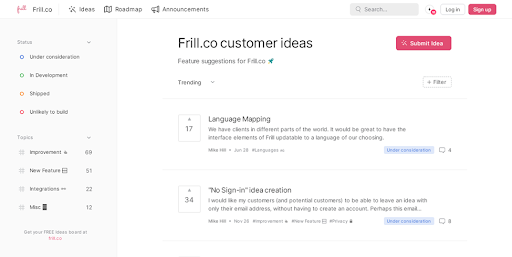
Frill is designed for SaaS teams that need structured feedback workflows without the operational overhead of enterprise product management platforms. You can embed Frill directly into your website or app or use its standalone web platform, giving teams a centralized way to collect feedback, prioritize requests, publish roadmaps, and announce product updates.
Unlike many lightweight feedback tools, Frill combines simplicity with more advanced capabilities like prioritization scoring, SSO, segmentation, roadmap management, and changelogs — all within a clean, highly approachable interface.
Frill’s feature request management tools include Ideas for capturing product feedback and requests, Roadmap for sharing product direction publicly, and Announcements for closing the feedback loop with customers.
Top features
Customizable in-app widgets
Idea upvoting and commenting
Automatic notifications
Feature request prioritization matrix
Changelog and announcements
Public roadmap
SSO
Vote on behalf of users
10 platform integrations
Pros and cons
Frill strikes a strong balance between usability and operational maturity. The platform is especially well-suited for startups and growing SaaS companies that want structured product feedback workflows without needing a heavyweight enterprise system. One of the best pros is there's no per-user pricing so you don't get locked into fee increases.
However, Frill is intentionally focused on feedback management rather than broader product operations. Teams looking for advanced CRM-driven prioritization, AI feedback analysis, or extensive enterprise governance may prefer more complex platforms.
Pricing
Frill’s Startup plan begins at $25/month and includes Ideas, Roadmap, and Announcements with up to 50 active ideas, making it accessible to manage your feature request process. The Business plan costs $49/month and includes unlimited ideas.
4. Trello
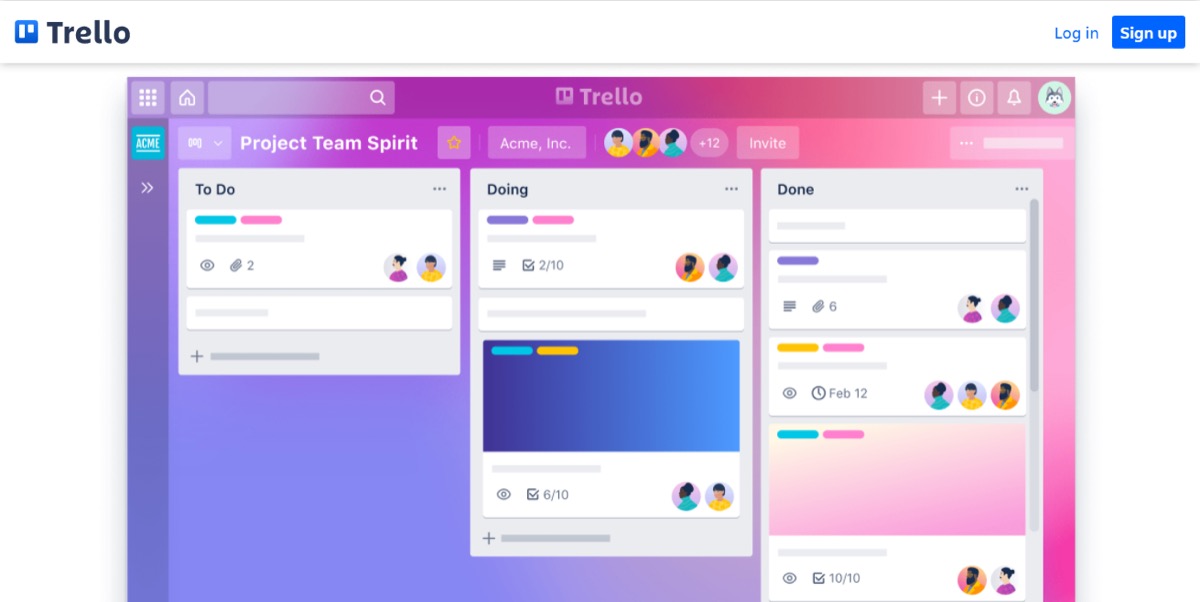
Trello is one of the most popular platforms for collecting feature requests. That’s because the tool has been around for a long time. However, Trello’s customer feedback boards are not the most intuitive.
Top features
Custom backgrounds and stickers
iOS and Android mobile app widgets
Two-factor authentication security
Pros and cons
Trello is a well-known project management software that offers easy-to-use Kanban boards. While it's not intended for feature requests, many software companies use it this way because it's free. You won't get advanced features like upvoting, a changelog, or public roadmaps, however. In this case, it might be worth exploring alternative tools' options or some form of custom offshore software development.
Pricing
Trello is available for free. However, if you want unlimited boards for collecting user feedback, you will need a paid plan. You can choose the $5 or $10 a month plan, but you will only get public board management if you pay $17.50 monthly.
5. Feature Upvote
Feature Upvote simplifies feature request collection by allowing you to gather all your customer feedback in one online board. Users can also upvote feedback so that you can identify the most important ones. This software is targeting game developers as their main target audience, so if that's you then this one is worth a closer look.
Top features
Private and public feedback boards
Unlimited contributors and team members
Multiple languages
SSO for users
Slack, Microsoft Teams, Jira, and Zapier integration
Pros and cons
Feature Upvote gives you essential features like SSO, multilanguage capabilities, and popular integrations, but the pricing is high. You can find more affordable options elsewhere.
Pricing
Feature Upvote pricing starts at $49/board/month for the Bootstrapper plan with unlimited contributors, SSO, integrations, and private boards. The $99/board/month Standard plan adds priority support. Enterprise pricing is available for larger teams needing custom terms, audits, or bulk board pricing. All plans include GDPR compliance and same-day support.
6. Userback
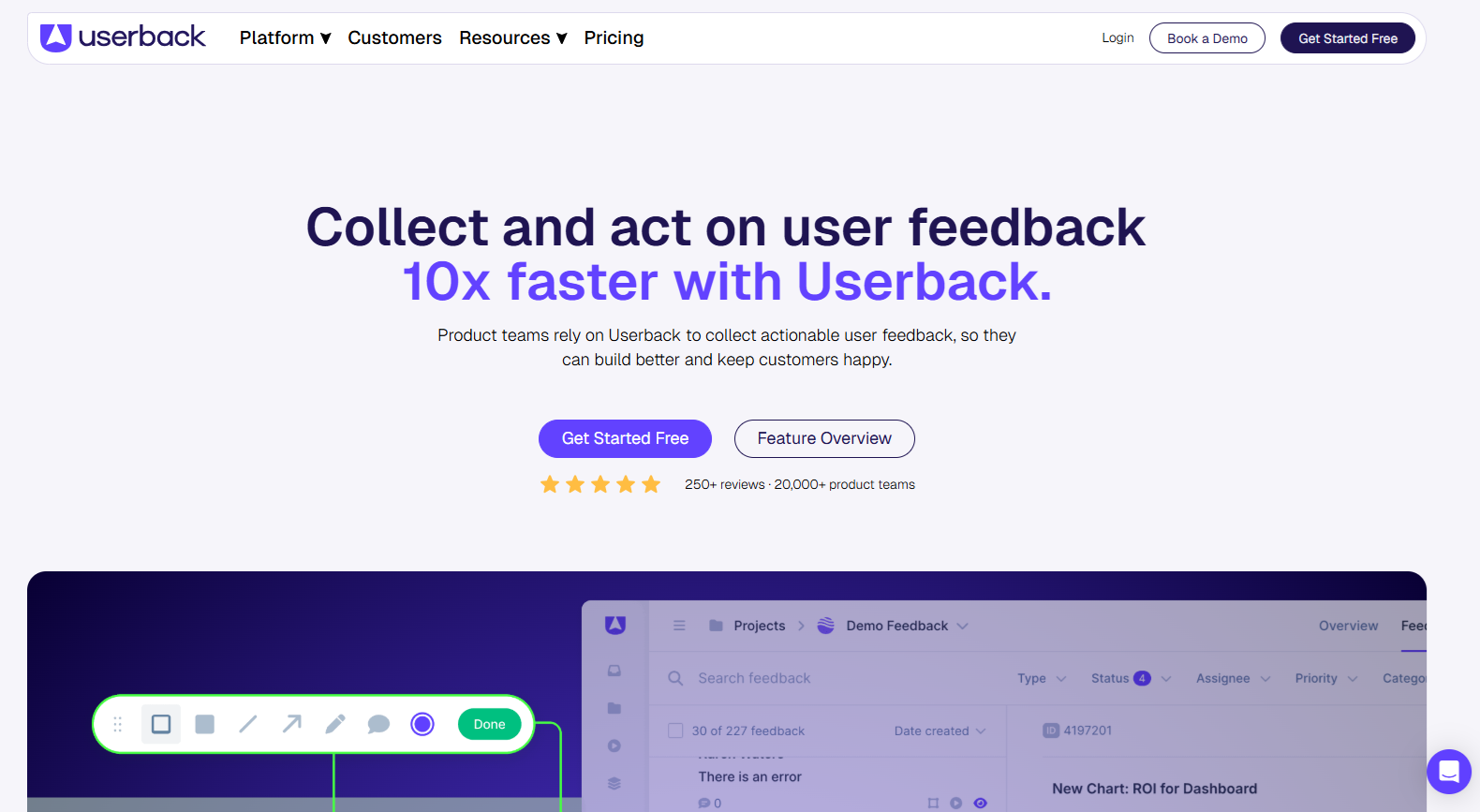
Userback is a comprehensive user feedback platform designed to help product teams collect and act on feedback efficiently. By offering multiple feedback collection methods—such as widgets, surveys, and video recordings—Userback ensures that teams gain valuable insights to improve their products.
Top features
Feedback widget with screen annotation
User surveys (NPS, CSAT, CES)
Feature portal with voting
Browser extension for easy feedback collection
Session replay and video feedback
Custom branding and integrations with Jira, Slack, and more
Pros and cons
Userback provides a highly visual and interactive feedback experience, making it easy for users to report issues directly. However, the pricing can be steep for smaller teams, as essential features like advanced survey triggers and branding customization are locked behind higher tiers.
Pricing
Userback offers a Free plan for early-stage teams with 2 seats and core feedback collection features. Paid plans start at $29/month for the Team plan, which includes unlimited feedback retention, project management integrations, automation, customizable widgets, and an optional feature portal add-on. The $79/month Business plan adds AI feedback insights, session replays, surveys, behavioral targeting, and custom branding. For larger organizations, the $159/month Business Plus plan includes unlimited projects, SSO, advanced privacy controls, API access, premium support, and enterprise-grade customization options.
7. UserVoice
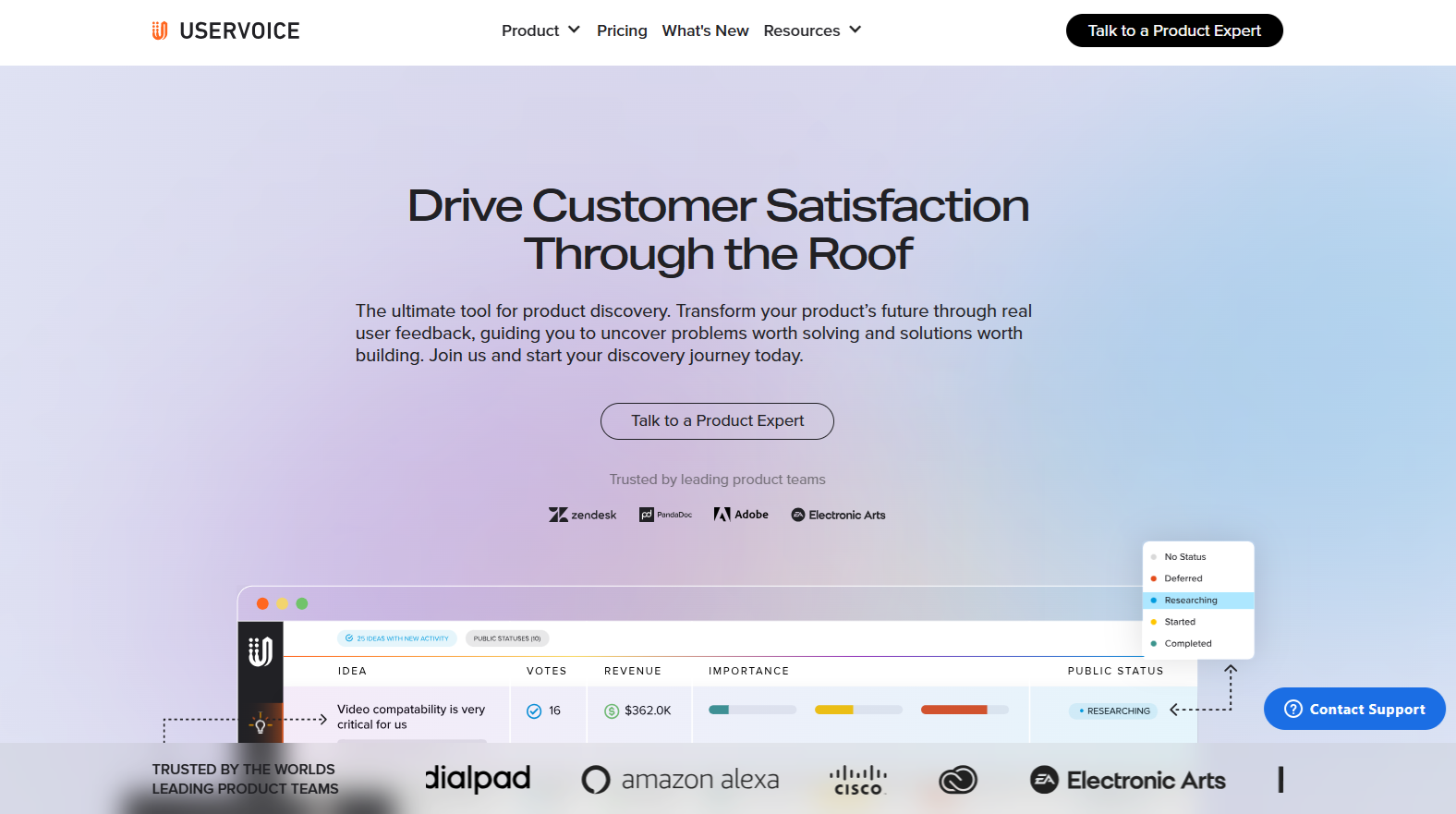
UserVoice provides B2B and SaaS companies with the insights needed to deliver the products and features their users desire the most. Even better, you can view customer reactions to your response to feature requests with UserVoice. The customer reactions can help you ascertain if you made the right decision.
Top features
In-app widget
Feature announcements
Salesforce, Slack, and Zendesk integration
Customer satisfaction and Net Promoter Score surveys
Pros and cons
UserVoice offers advanced integrations, user segmentation, and customer satisfaction ratings. But they only offer Enterprise-grade plans, making it a poor choice for small- and medium-sized businesses.
Pricing
UserVoice offers custom pricing based on feedback volume and integrations, with plans starting at approximately $16,000 per year. All plans include unlimited seats, customer segmentation, advanced filtering, onboarding support, and enterprise-grade security. A 30-day trial is available for teams evaluating the platform.
8. ProdCamp
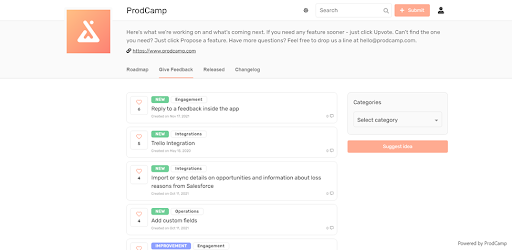
ProdCamp aids feedback collection from digital channels, meetings, interviews, and customer service interactions. If you need to find specific feature requests, you can find them quickly by entering keywords into the platform’s search tool.
Top features
Chrome extension
In-app feedback
Public roadmap
Impact-effort matrix
RICE prioritization
Pros and cons
ProdCamp has a decent free plan, but the pricing jumps up to $99 from there. Unless you love their prioritization features, the high monthly cost won't be worth it.
Pricing
ProdCamp offers a free plan ideal for indie founders. The $99/month Startup plan includes 5 admin users, while the $299/month Business plan adds support for 3 products and 10 admins. Enterprise plans offer unlimited products, users, and customization—perfect for scaling teams with advanced product feedback needs.
9. Featurebase
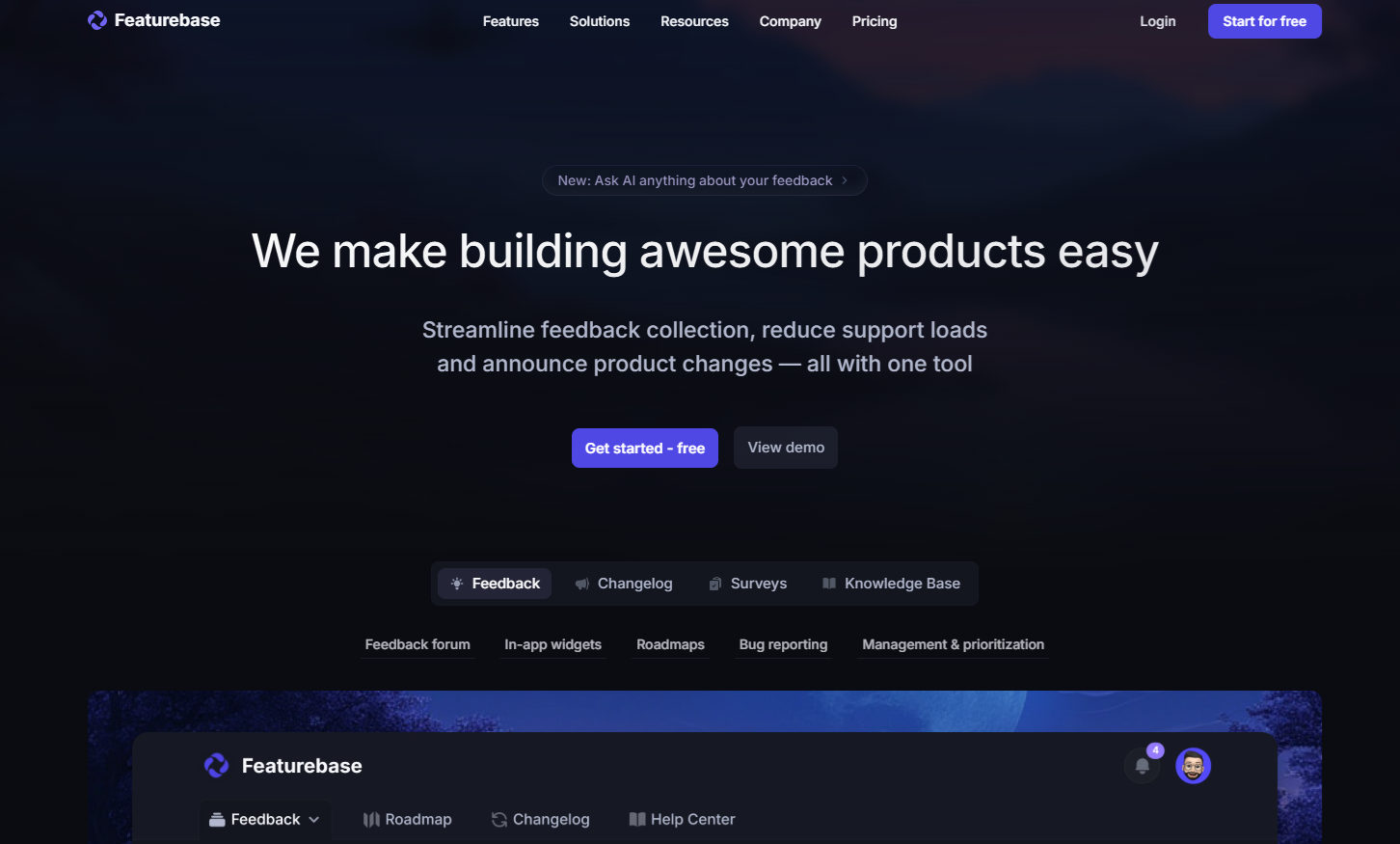
Featurebase is a user feedback and feature request tracking platform designed to help product teams collect, manage, and prioritize user input. With built-in AI-powered deduplication, revenue-based prioritization, and seamless integrations, Featurebase makes it easier to identify the most impactful feature requests and turn them into actionable insights.
Top features
Feedback forum for users to submit, vote, and comment on feature requests
In-app feedback widgets for collecting feedback directly from your app
AI duplicate detection to automatically merge similar feedback submissions
Prioritize by revenue to see the total revenue associated with upvoters
Automatic email updates to notify users when their requested features progress
Roadmap management to share what’s in progress and upcoming
Powerful integrations with Slack, Intercom, Jira, GitHub, and more
User authentication with SSO and SDK to connect feedback with user profiles
Pros and cons
Featurebase excels in simplifying feedback collection and prioritization with AI-driven organization and revenue-based sorting. However, its free plan is quite limited, and more advanced customization requires a higher-tier subscription.
Pricing
Featurebase offers a free plan for individuals, while paid plans start at $29/seat/month for growing startups. The $59/seat Professional plan adds AI deduplication, segmentation, analytics, and API access. Enterprise plans start at $99/seat/month with advanced permissions, SSO, CRM integrations, and unlimited feedback boards and roadmaps.
10. Beamer
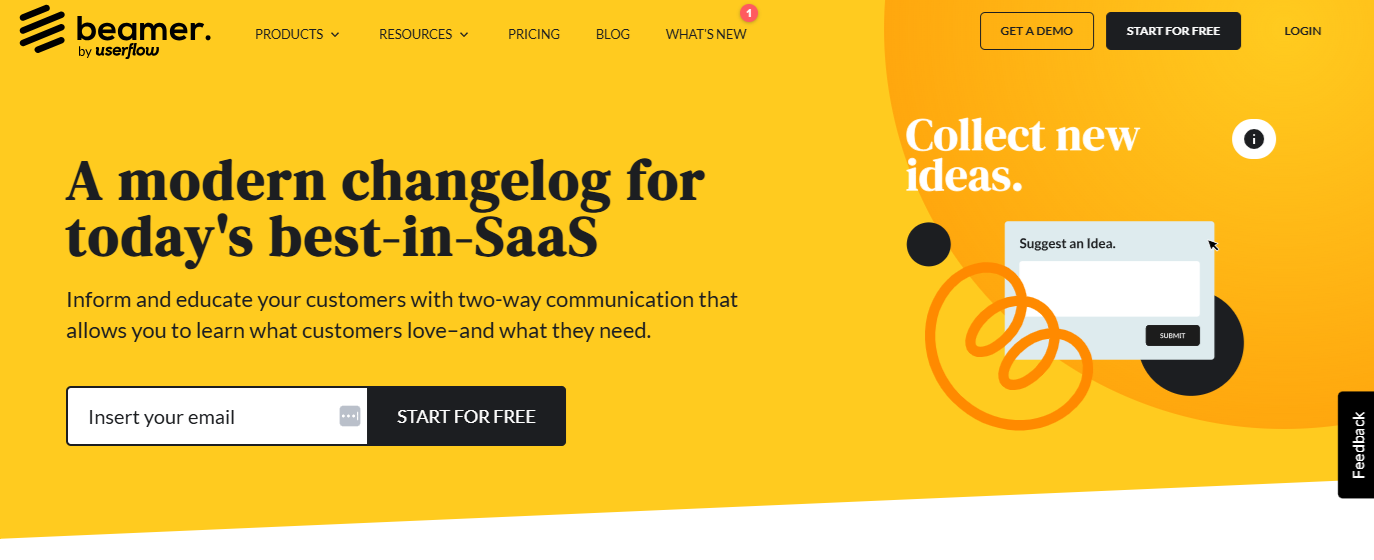
Beamer is a customer communication and feedback platform designed to help SaaS companies engage users, track feature requests, and improve product adoption. With a modern changelog, in-app notifications, and NPS surveys, Beamer enables product teams to gather insights and communicate updates seamlessly.
Top features
Changelog to showcase product updates and new features
In-app notifications for targeted messaging and announcements
NPS surveys to measure customer satisfaction and identify trends
Feedback collection with voting, prioritization, and user conversations
Automatic status tracking to keep users informed on feature progress
Public and private roadmap for transparent product development
Third-party integrations with Slack, Zapier, and other platforms
API and webhooks for custom automation and data syncing
Segmentation to target user groups with personalized announcements
Easy installation with a simple embed code or WordPress plugin
Pros and cons
Beamer makes it easy to communicate product updates and collect valuable user feedback, leading to improved engagement and feature adoption. However, it may lack some of the advanced customization and analytics features that larger enterprises require.
Pricing
Beamer offers three pricing tiers based on team size and user engagement needs. The Starter plan costs $49 per month and includes 5,000 Monthly Active Users (MAUs), a standalone changelog, boosted announcements, appearance customization, and analytics. The Pro plan, at $99 per month, supports 10,000 MAUs and adds a dedicated inbox, comments and reactions, and basic segmentation. The most popular Scale plan is priced at $249 per month, offering 50,000 MAUs along with advanced segmentation, user activity tracking, and a staging account. Additional MAUs and feedback or NPS add-ons are available for all plans.
11. Nolt
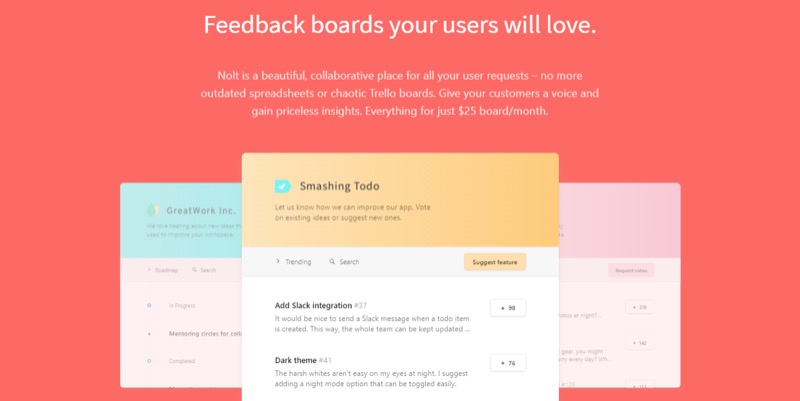
Nolt offers private and public feedback boards for gathering valuable insights. Private feedback boards are typically accessible by team members or a specific group of customers. Public feedback boards are open to everyone, letting users suggest new features or software improvements.
Top features
Idea upvoting
Single Sign-On
Anonymous voting
Custom branding
Roadmap
Pros and cons
Because SSO is available on all plans, Nolt is a decent option for feature requests. But the lack of a changelog feature means you'll need to add another software tool to your tech stack—so their affordable pricing isn't as affordable as it would seem.
Pricing
Nolt offers simple flat-rate pricing starting at $29/month for one board and core features like SSO and integrations. The $69/month Pro plan adds up to five boards, advanced moderation, and expanded integrations. Enterprise plans include unlimited boards, advanced SSO, invoicing, and enhanced security for large organizations.
12. Canny
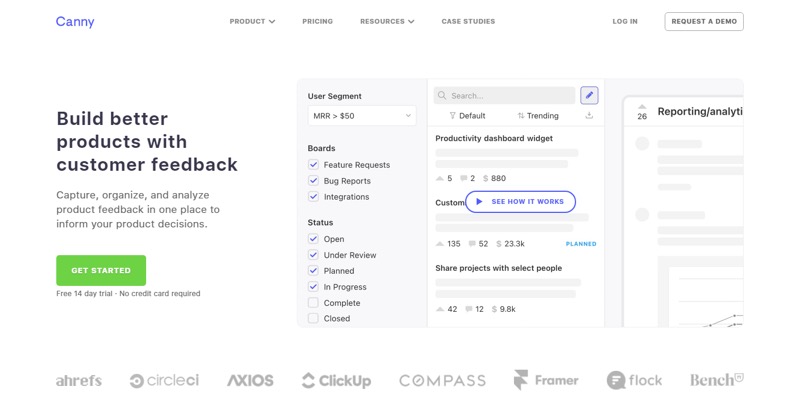
Canny is a robust tool that can help you understand the users that send feature requests. The platform also offers the option to manage feature requests on your behalf.
Top features
Automated or manual feature request management
Public roadmap
Public and private feedback boards
Feedback analytics
User segmentation
Changelog
Single-sign on
Pros and cons
With Canny's free plan, you get 2 idea boards, 1 roadmap, and 1 integration. But as soon as you need a custom domain, custom branding, or more integrations, you'll have to upgrade to their $400-per-month plan. Because of the high cost, you're better off looking elsewhere.
Pricing
Canny offers a limited free plan with up to 25 tracked users. Paid plans become expensive quickly as your feedback volume grows. The Core plan starts at $249/month for 1,000 tracked users or $525/month for 5,000 users, while the Pro plan jumps to $529–$1,079/month for advanced workflows, integrations, and reporting. Enterprise features like CRM integrations and SSO require custom Business pricing.
13. UseResponse
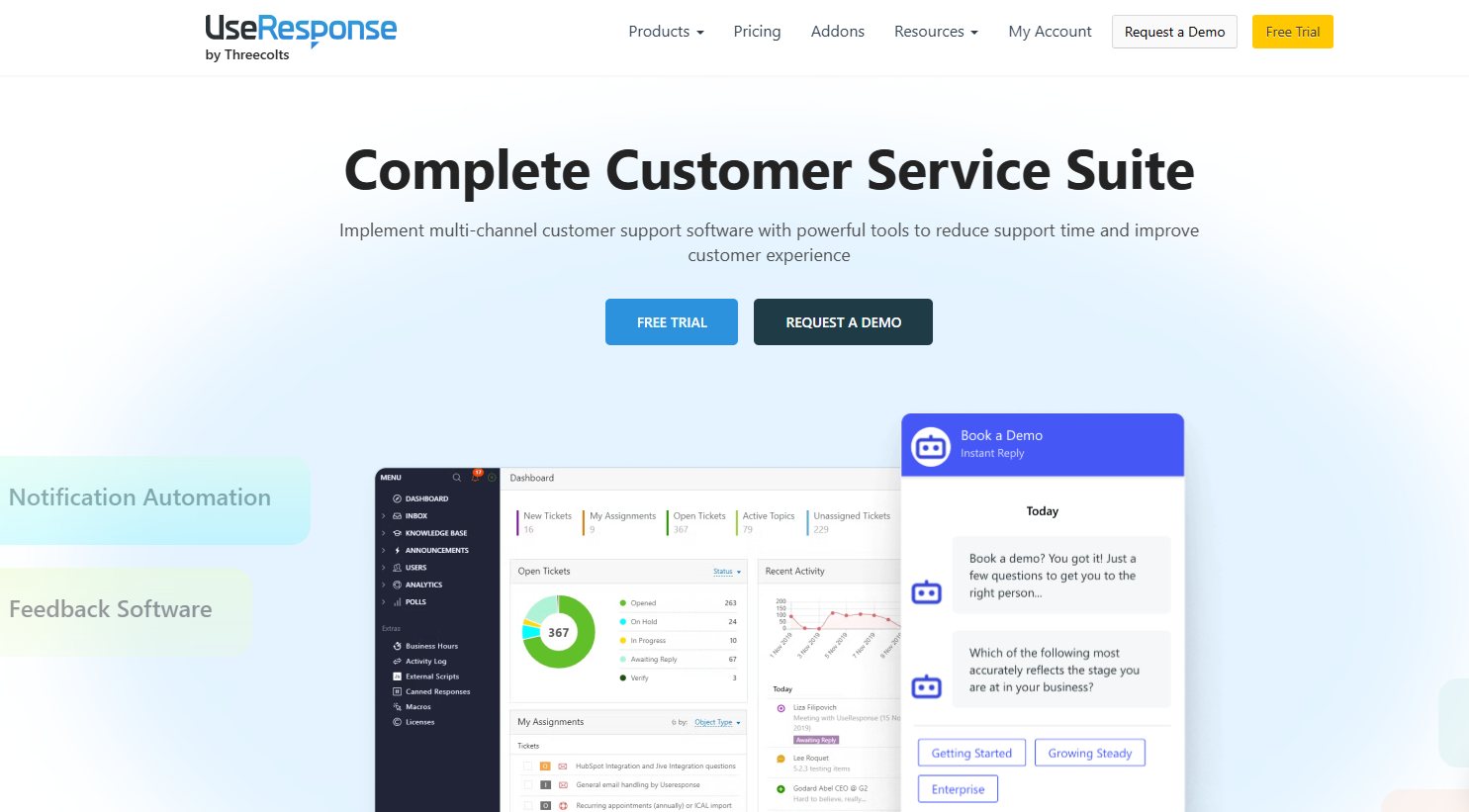
UseResponse is a flexible customer feedback and feature request tracking platform designed to help businesses gather, manage, and prioritize user insights. With a comprehensive feedback portal, roadmap management, and automation tools, UseResponse enables teams to streamline feature tracking and engage users in product development.
Top features
Feedback portal for public or private feature request submissions
Advanced voting system with vote limits and automated prioritization
Multiple boards to track feedback across different products or languages
Product roadmap to showcase planned and in-progress features
Smart moderation tools to review feedback before it goes live
Triggers and automations to streamline request processing
Internal notes and discussions for team collaboration on feature ideas
Single Sign-On (SSO) for secure user authentication
Deadline tracking to ensure timely feature development
Analytics & trends to measure feedback trends and team performance
Pros and cons
UseResponse provides a highly customizable feature tracking system with automation and moderation tools, making it ideal for both public and internal use. However, the per-agent pricing model may be cost-prohibitive for larger teams compared to flat-rate alternatives.
Pricing
UseResponse’s Enterprise Cloud Support Suite costs $49 per agent/month and includes a feedback system, help desk with live chat, and knowledge base. The On-Premise Support Solution is $120 per agent/month (billed annually), starting at five agents, offering open-source access and full control on your own server.
14. GetFeedback
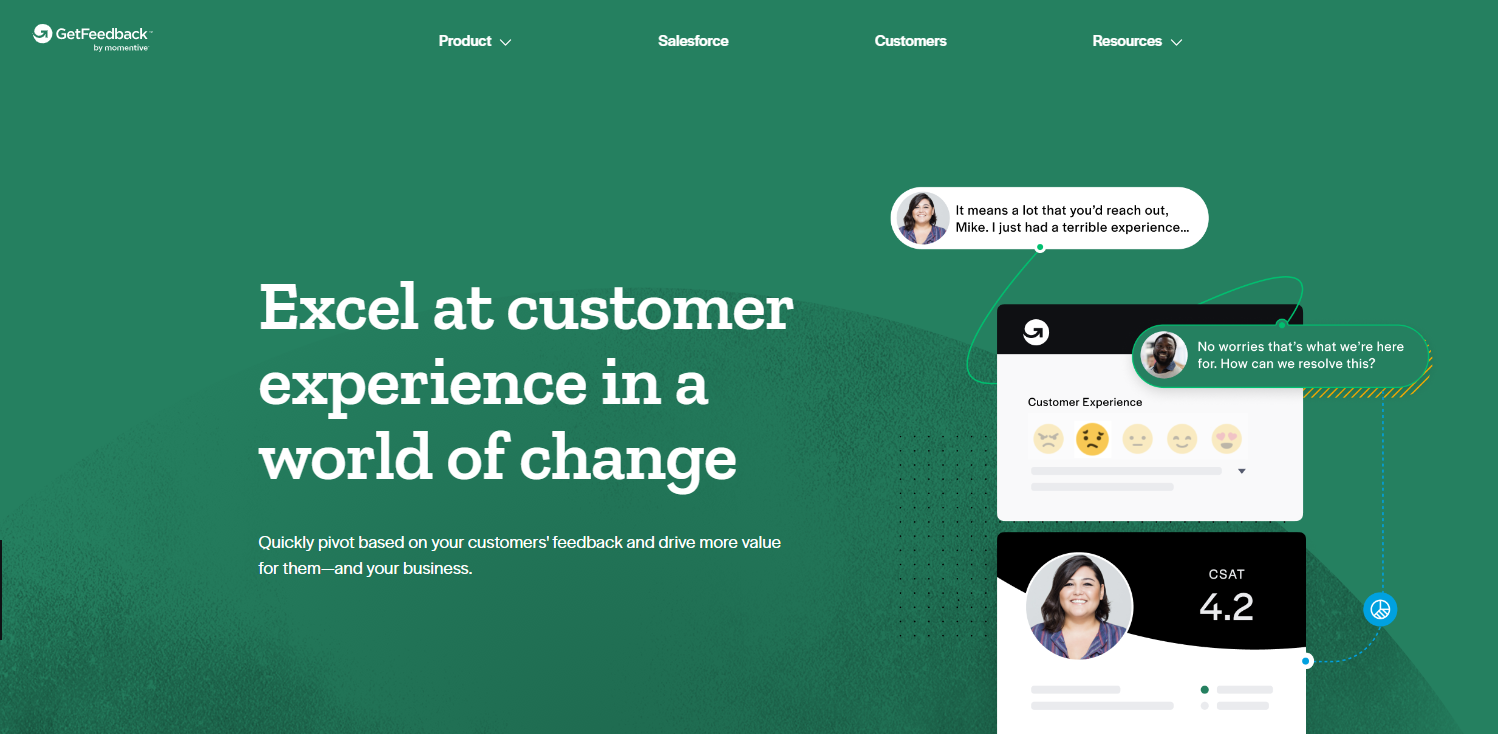
GetFeedback offers website, email, and app widgets that collect feature requests and other types of user feedback.
Top features
Net Promoter Score (NPS)
Customizable widgets
Engagement tracking
User segmentation
Request feedback via email and SMS
In-app feedback for mobile apps
Pros and cons
GetFeedback is a comprehensive customer feedback platform best suited for consumer brands that need to collect and prioritize a high volume of feedback. For software feature requests, you're better off choosing a platform dedicated to the SaaS industry, which will offer a public roadmap and changelog while costing less.
Pricing
GetFeedback doesn't publish their pricing online, so you'll need to contact them for a custom quote.
15. Upvoty
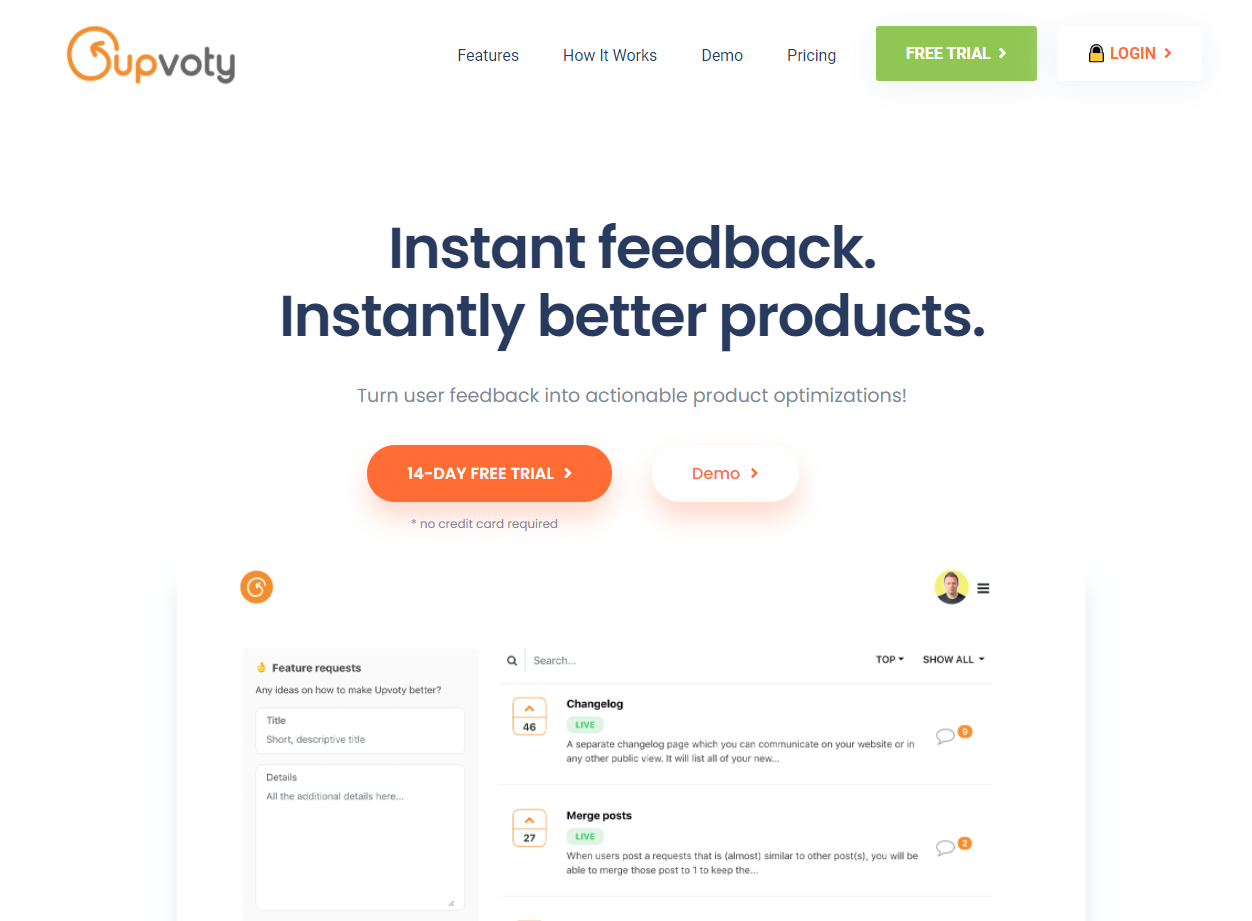
Upvoty comes with feedback portals and boards that your users can use to request new features, bug fixes, and more. You can embed Upvoty feedback boards on your website or app, and users can provide feedback anonymously or without signing up.
Top features
Product roadmap
Changelog for updates
Customizable feedback portal
App and website widgets
Pros and cons
Upvoty offers a strong all-in-one feedback experience with public boards, roadmaps, changelogs, voting, integrations, and SSO included even on lower-tier plans. The platform is especially appealing for startups and smaller SaaS teams that want modern feedback workflows without enterprise-level pricing or complexity.
However, the product is more lightweight than platforms focused on advanced prioritization, analytics, or large-scale product operations. Teams with complex internal workflows or deeper customer intelligence requirements may eventually outgrow it.
Pricing
Upvoty’s pricing starts at $25/month for the Power plan, which includes unlimited users, unlimited boards, custom domains, integrations, segmentation, and custom SSO. The $49/month Super plan offers the same feature set, while the $99/month Hyper plan adds unlimited projects for larger teams managing multiple products or feedback portals.
Feature request tools are becoming product operations systems
Modern feature request software does far more than collect ideas on a public feedback board.
The strongest product teams now use feature request tools as part of a broader product operations workflow, connecting customer feedback to prioritization, retention, revenue impact, and roadmap planning.
Feature requests should be treated as signals, not instructions.
A highly requested feature may still be low priority if it doesn’t align with your product strategy, customer segments, or business goals. That’s why consolidation matters more than collection alone. Modern teams need systems that centralize feedback from support tickets, sales calls, surveys, Slack conversations, and customer interviews into a single prioritization workflow.
The goal is no longer to simply gather ideas. The goal is to make smarter product decisions with clearer customer context.
Frequently asked questions about feature request trackers
Check out these answers to important FAQs.
Which feature request tool should I choose?
The best feature request tool depends on your needs. For best value, Frill offers powerful features like SSO, changelogs, and integrations starting at just $25/month. UserVoice is ideal for large teams needing enterprise-level reporting and workflows. If you're looking for a great free plan, try Sleekplan or Upvoty, which offer voting and roadmaps at no cost. For teams needing broad integration options, Savio connects with Slack, Intercom, HelpScout, and more to centralize feedback from multiple sources.
What are the most critical features to look for?
A solid feature request management tool should have user SSO so people can log in easily, a widget so they can submit ideas anytime, and upvoting to see what’s popular. Also look for a product roadmap, which keeps everyone in the loop, and a changelog that shows what’s been shipped.
What are some advanced features to consider?
For smarter feature request tracking, look for AI-powered duplicate detection, auto status updates, and integrations with tools like Slack or Jira. Bonus points for revenue-based prioritization, workflow automation, and segmentation—these help you focus on what really moves the needle. You might also want to incorporate feature request templates to increase participation.
How can I make feature requests easier for our users?
Drop a feature request widget into your website and app so users can share ideas anytime. Also, set up SSO on your feedback board so they can log in without hassle. Less friction = more great ideas flowing into your feature request tool.
How do AI tools help with feature request deduplication?
AI tools help with feature request deduplication by automatically identifying similar or duplicate ideas submitted by users. Instead of manually sorting through dozens (or hundreds) of overlapping suggestions, AI analyzes the language, keywords, and context of each request to group related feedback together. This prevents clutter, ensures no valuable input is lost, and helps product teams see the full demand behind popular ideas. With deduplication, it’s easier to prioritize features based on real user interest—without inflating vote counts or missing patterns.
Start tracking feature requests in one place
Before choosing a feature request tool, verify that it fits your budget and has everything needed to motivate users to give feedback. Frill fits this description because it's affordable and easy to navigate with an attractive interface.
Frill offers custom domains, user SSO, and 10 integrations on all of our plans, starting at just $25 per month.
Sign up to try one of Frill's low-cost plans and discover why it’s the go-to feature request platform for SaaS companies.