Did you try UserVoice and find it unideal for your company, users, or budget? Discover UserVoice alternatives that could be a better fit.
UserVoice built its reputation as the go-to enterprise feedback tool — and for large organizations with the budget to match, it still delivers. But at $699/month minimum, it prices out a huge portion of the SaaS companies that actually need a product feedback tool most, which are the growing teams trying to stay close to their users without a dedicated team to manage the platform.
I’ve worked with hundreds of SaaS teams through Frill, and the pattern I see most often is this: companies leave UserVoice not because it doesn’t work, but because it asks too much. Too much money, too much setup, too much ongoing maintenance. According to a HubSpot report, most users quit the feedback process if it’s needlessly long or complicated. The same applies to the tools teams use to collect it.
If UserVoice isn’t the right fit for your company, your users, or your budget, here are seven alternatives worth considering, and what each one is actually best for.
What to look for in a UserVoice alternative
UserVoice might be a popular feedback tool, but it’s not perfect. One of its biggest shortcomings is its price. The base package costs $799 per month, which can be pricey for a start-up. Businesses that want even more features must shell out as much as $1,499 a month.
Another reason you might want a UserVoice alternative is the complaints about the platform’s steep learning curve. Many of the UserVoice competitors that made our list are more affordable, user-friendly, and just as effective.
Which UserVoice alternatives are free or affordable?
UserVoice offers a 21-day free trial. Once the trial ends, you must subscribe to a paid plan to keep using the platform.
UserVoice’s plans are very expensive, with the lowest plan starting at $699 per month as part of an annual contract.
If you want an affordable user feedback tool that offers many of the same features as UserVoice, you cannot go wrong with Frill.
Unlike other free UserVoice alternatives, Frill’s low plans offer unrestricted access to its primary feedback collection and roadmap tools, such as the Ideas and Roadmap Portal. You’ll pay just $25 per month on the Startup plan or $49 per month on the Business plan, which unlocks unlimited tracked ideas from users.
Top UserVoice alternatives
Choosing a UserVoice alternative isn’t just about finding something cheaper. It’s about finding something that actually fits how your team works. I evaluated each tool on this list against the same criteria I’d use if I were making the switch myself:
Meaningful overlap with UserVoice. Every tool here handles at least the core use case—feedback collection, prioritization, and roadmapping. I didn’t include survey-only tools or project management platforms that happen to have a feedback module bolted on.
Verified user reviews. I only included tools with real ratings on G2 or Capterra. Vendor claims alone don’t tell you what it’s actually like to use something day to day.
Transparent or justifiable pricing. Tools that hide pricing behind a sales call got extra scrutiny. If I can’t find a starting price on the website, that’s usually a signal it’s not built for the teams most likely to be leaving UserVoice.
A range of use cases and budgets. UserVoice customers range from scaling startups to enterprise orgs. I made sure this list covers that range—from Frill at $25/month to Pendo and Aha! at the enterprise end—so there’s a credible option regardless of where you sit.
Active development. Every tool here is actively maintained and shipping updates. A feedback platform that isn’t evolving is a liability.
With those criteria in mind, here are the seven best UserVoice alternatives available right now.
1. Pendo: Best for enterprise teams needing analytics alongside feedback
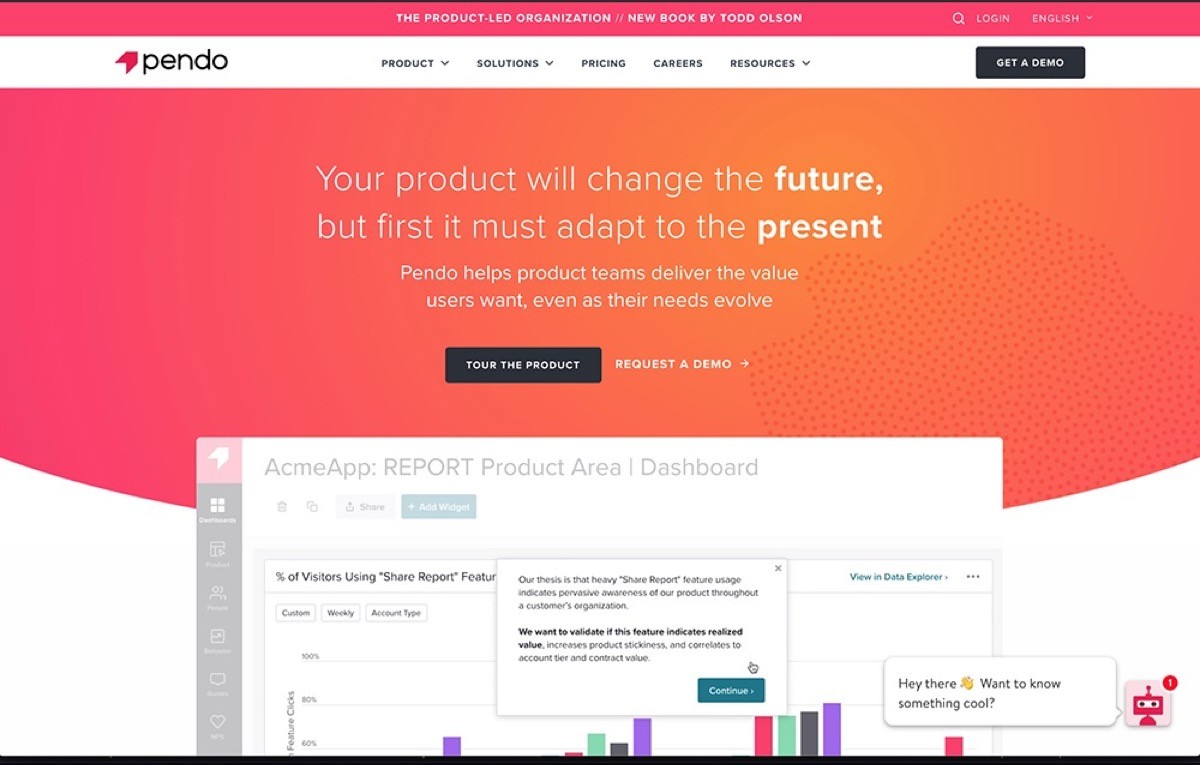
Unlike some of the UserVoice alternatives on our list, Pendo does more than collect and analyze user feedback. It comes packed with behavioral analytics, in-app guides, session replays, and NPS surveys — making it one of the most feature-rich platforms available for teams that want to understand not just what users are asking for, but how they’re actually using the product.
For instance, the platform offers behavioral analytics that provides insights into how customers interact with your product. You can also get metrics that score product engagement, user satisfaction, and customer sentiment.
Features:
User onboarding
Feedback collection
Product analytics
Roadmaps
Customer sentiment surveys
Pricing:
Pendo has a free plan that offers limited access to the platform’s top features. You can opt for a paid plan if you want access to more features, but you have to contact the company for a custom quote. Pendo’s pricing isn’t published online.
Ratings:
4.4 stars on G2
4.5 stars on Capterra
Pros and cons:
Pendo is the closest thing on this list to a true enterprise-for-enterprise UserVoice replacement — it handles feedback collection alongside behavioral analytics and in-app guidance in a way that nothing else here does. With 1,794 G2 reviews, it’s also the most validated option. The cost is the catch: pricing isn’t published, which signals a budget well above Frill or Gleap, and reviewers consistently flag a steep learning curve and cumbersome tagging setup. Unlike Frill or Craft.io where a PM can be live quickly, Pendo typically requires engineering involvement. If you need analytics depth, it earns its price. If you need a simple feedback board, it’s overkill.
2. Frill: Best all-in-one UserVoice alternative

Frill is a customer feedback tool with a user-friendly interface that outclasses many of its competitors. I’ve watched teams switch from UserVoice to Frill and immediately notice the difference — not just in cost, but in how quickly they can get users engaged. Where UserVoice can feel like a platform built for enterprise ops teams, Frill feels like it was built for product managers who just want to get things done.
Besides simplifying user feedback collection, Frill offers roadmap and product announcement tools for keeping users updated about the actions you take regarding their feedback. Letting customers know you value their input enough to act on it is a surefire way to boost customer loyalty.
Features:
Customer feedback idea board
Website widget
Announcements portal and automatic notifications
Changelog
Custom domain
Roadmap and idea upvoting
Third-party integration
Pricing:
Frill offers simple, scalable pricing for every stage. Startup is $25/month for 50 ideas and 1 survey. Business is $49/month with unlimited ideas and 3 surveys. Growth is $149/month with everything included. Enterprise starts at $349/month with SOC2, audit logs, and support. Add-ons include Surveys, Privacy, and White Labeling.
Ratings:
4.9 stars on G2
4.7 stars on Capterra
Pros and cons:
At $25/month, Frill costs a fraction of UserVoice’s $699/month minimum while covering the core feedback loop — idea collection, roadmap, announcements, and surveys — in one place. One G2 reviewer noted a 40% increase in idea board engagement after switching, which I’ve seen reflected in how quickly teams get traction with it. The tradeoff is depth: Frill is built specifically for SaaS and digital products, so teams needing enterprise-grade analytics or complex stakeholder workflows will hit limits faster than they would with Aha! or Productboard.
3. Productboard: Best for large product teams managing complex roadmaps
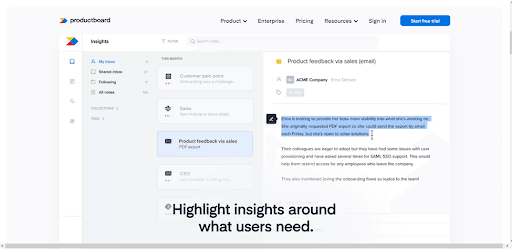
Productboard facilitates user feedback collection and analysis to help companies understand customer needs. Understanding customers’ desires and preferences will enable you to constantly improve your product to keep users happy and your business ahead of competitors.
Features:
Analytics prioritization
Roadmap
Feedback idea boards
Insight trends and automation
Feedback filters
Pricing:
Productboard offers four pricing tiers. The Starter plan is free and includes 50 feedback notes and 1 Product Portal. Essentials starts at $19/maker/month billed annually. Pro starts at $59/maker/month and adds segmentation and advanced reporting. Enterprise has custom pricing, starting at 5 makers, with features like SAML SSO and Salesforce integration.
Ratings:
4.3 stars on G2
4.7 stars on Capterra
Pros and cons
With 254 G2 reviews and an enterprise-grade feature set, Productboard is the most validated tool on this list after Pendo. It excels at centralizing feedback, connecting it to roadmap decisions, and keeping large cross-functional teams aligned — which is exactly what most people are looking for when they leave UserVoice. The tradeoff is cost and complexity: at $19/user/month minimum, it scales up in price fast, and multiple reviewers flag a steep learning curve and an overwhelming interface. For smaller teams, Frill handles the core feedback loop at a fraction of the cost. For teams consolidating roadmapping and prioritization at scale, Productboard earns its place.
4. Aha! Best for product-led organizations needing a full suite
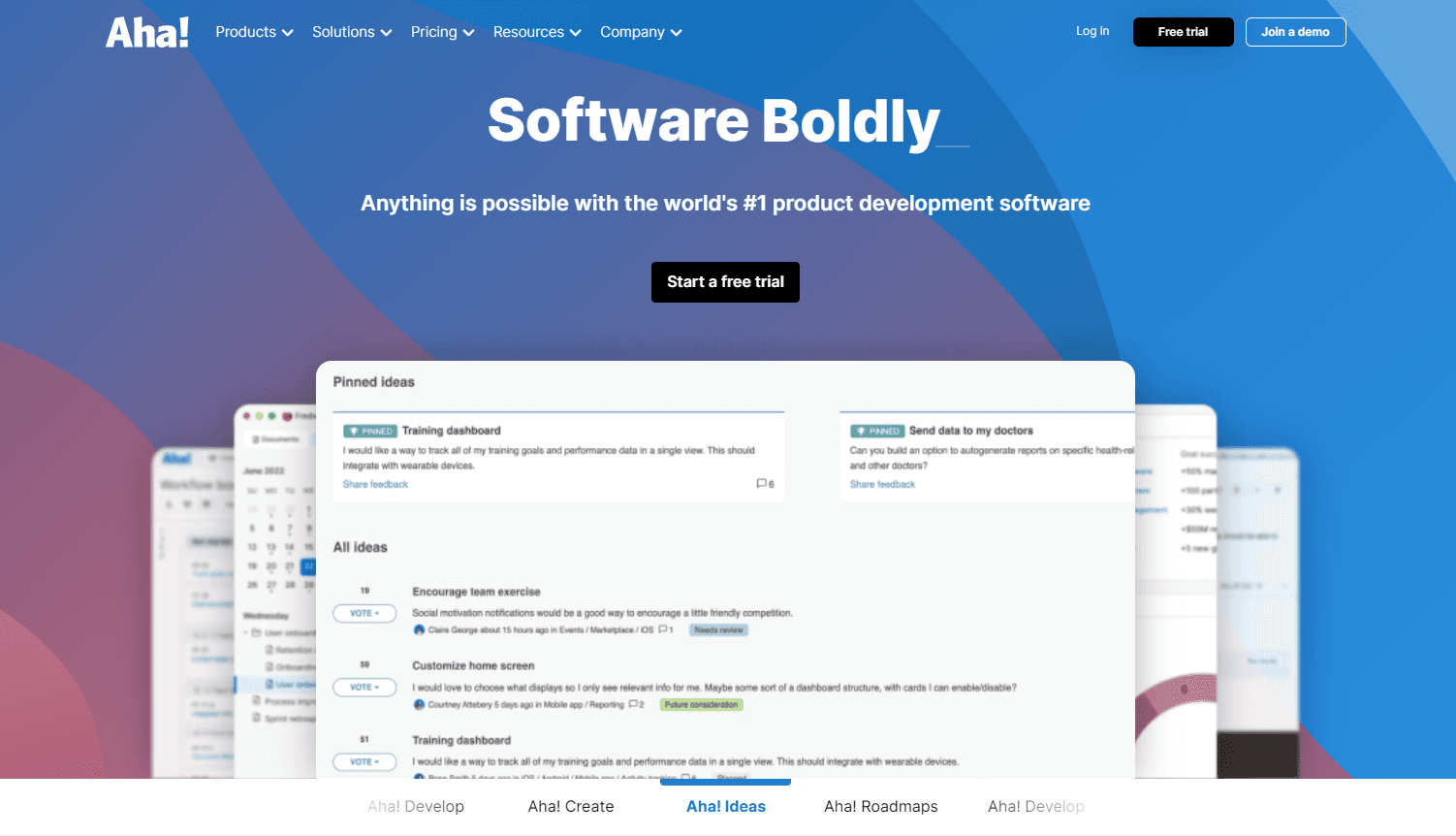
Aha! Ideas is a feedback tool that lets you crowd-source feedback and evaluate trends for better idea prioritization. You can get feedback through in-app widgets installed on your product and several other channels.
Features:
Centralized feedback
Customizable portals
Dynamic forms
Upvote ideas
In-app feedback widget
Pricing:
Aha! offers a suite of modular tools with separate pricing. Aha! Roadmaps starts at $59/user/month and includes ideas, whiteboards, and knowledge tools. Aha! Ideas and Discovery start at $39/user/month. Whiteboards, Teamwork, and Develop start at $9/user/month, while Knowledge starts at $18/user/month. Each product can be used standalone or integrated together. Pricing is billed annually.
Ratings:
4.4 stars on G2
4.7 stars on Capterra
Pros and cons
Aha! is the most comprehensive tool on this list — covering feedback portals, roadmapping, whiteboards, OKRs, and delivery planning in one integrated suite. With 365 G2 reviews and a 4.4 rating, it’s well-validated. SSO is included on all plans without an extra charge, which is a notable advantage over some competitors. The main friction is cost and learning curve: at $59/user/month for the premium plan, it’s significantly more expensive than Frill or Gleap, and reviewers consistently mention the time needed to get workflows configured correctly. It’s the right choice for product orgs that want a single platform from strategy to execution — not for teams who just need a feedback board.
5. ProdPad: Best for roadmap-first product teams
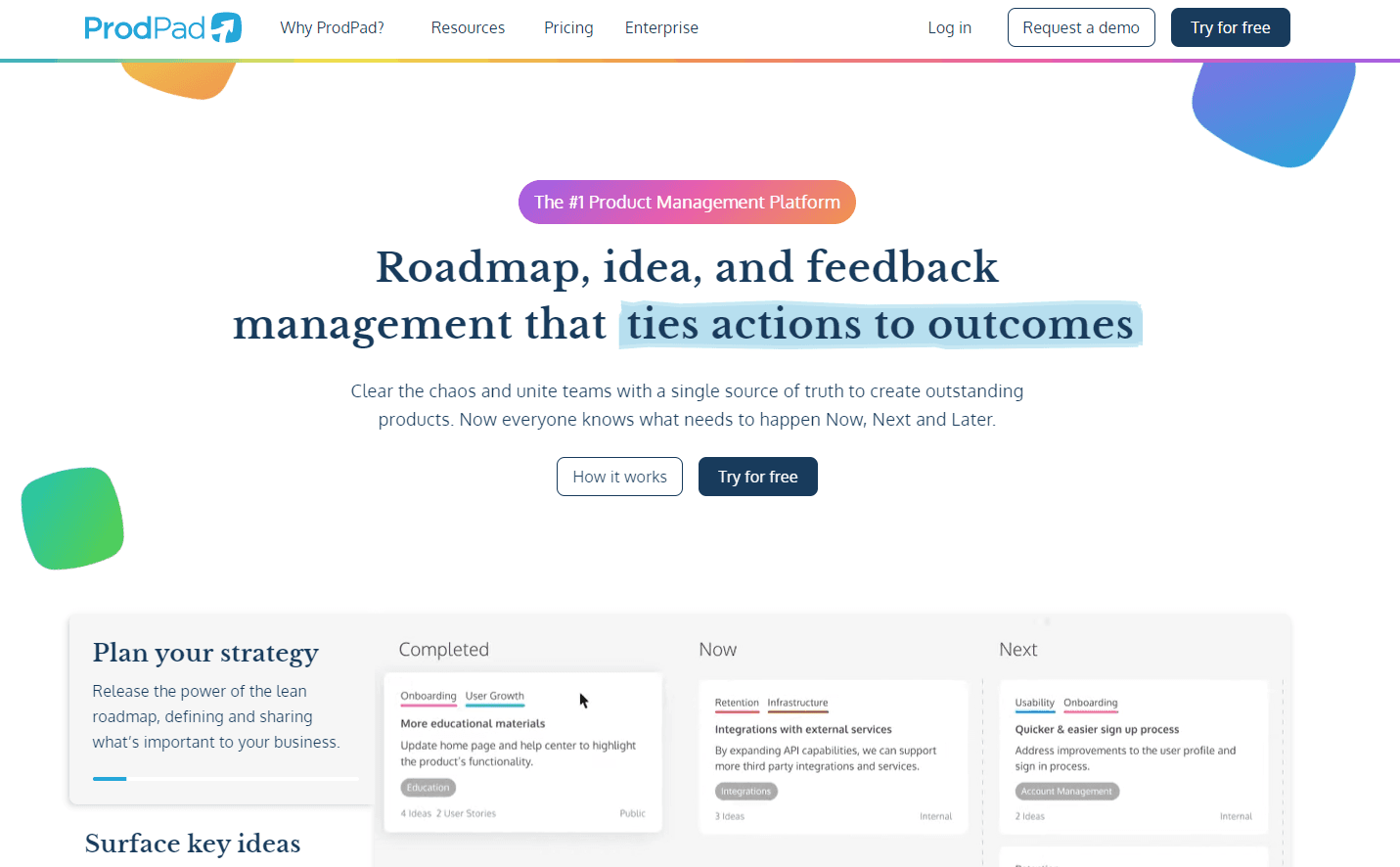
ProdPad offers user feedback and roadmap tools for engaging customers and learning how to improve your product quality and service delivery. The best thing about ProdPad is its user-friendly drag-and-drop interface that ensures team members can quickly adopt the platform and start making the most of it.
Features:
Product roadmap
Customer feedback and idea management
Third-party workflow integration
Backlog workflow
AI assistance
Pricing:
ProdPad offers modular pricing based on your needs. Each Essentials module (Roadmaps, Ideas, or Feedback) starts at $24/editor/month. Advanced versions add features like OKRs, integrations, or white-labeled portals from $36 to $44/editor/month. All plans include unlimited free Reviewer logins, AI assistance, and collaboration tools.
Ratings:
4.2 stars on G2
4.0 stars on Capterra
Pros and cons:
ProdPad’s modular pricing is genuinely useful — at $24/editor/month per module, teams can start with just what they need rather than paying for a full suite upfront, which makes it more accessible than Aha! or Productboard at entry level. The roadmapping functionality is strong, and AI assistance is included across all plans. The limitations compared to Frill or Gleap are notable: G2 ratings sit lower at 4.2 stars across 95 reviews, and adding multiple modules quickly pushes the total cost up. It’s best suited to product teams who prioritize roadmapping and backlog management over user-facing feedback collection.
6. Gleap: Best for teams prioritizing visual bug reporting alongside feedback
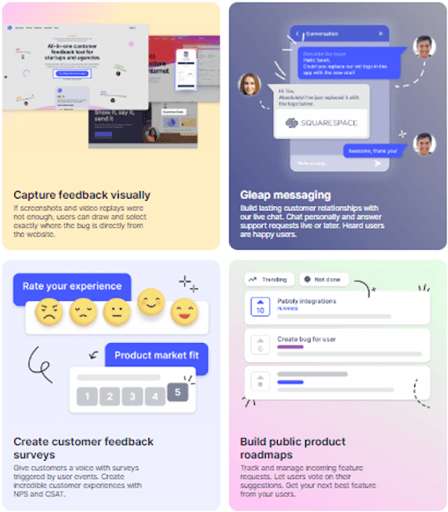
Gleap enables businesses to identify, understand, and fix bugs faster. Fixing bugs quickly and efficiently will keep users happy and reduce customer churn.
With the user feedback tool, you can automatically gather visual feedback (screenshots, videos, and session data) with all the metadata you need. The platform also offers surveys for collecting more user insights and a shareable roadmap for updating users about fixes and upgrades.
Features:
Feedback boards
Fully customizable feedback widget
Changelog
Shareable and embeddable roadmap
Pricing:
Gleap offers flexible pricing to fit teams of all sizes. The Basic plan starts at $31/month for 1 team member and 1 project. The Team plan is $119/month with unlimited members and projects. Enterprise starts at $799/month and includes API access, ticketing, and premium support. Startups get 50% off for 3 years.
Ratings:
4.7 stars on G2
5.0 stars on Capterra
Pros and cons:
Gleap is the strongest option on this list for teams where bug reporting and customer support are as important as feature requests — it captures screenshots, session data, and technical logs automatically, which no other tool here does natively. Pricing has changed since the original article: the entry plan now starts at $39/month, making it slightly more expensive than Frill. With 48 G2 reviews and a 4.6 rating it’s reasonably validated. The main limitation is focus — Gleap has expanded into AI support and live chat, which is powerful for some teams but adds complexity for teams who just need a clean feedback board and roadmap.
7. Craft.io: Best for enterprise product teams connecting strategy to execution
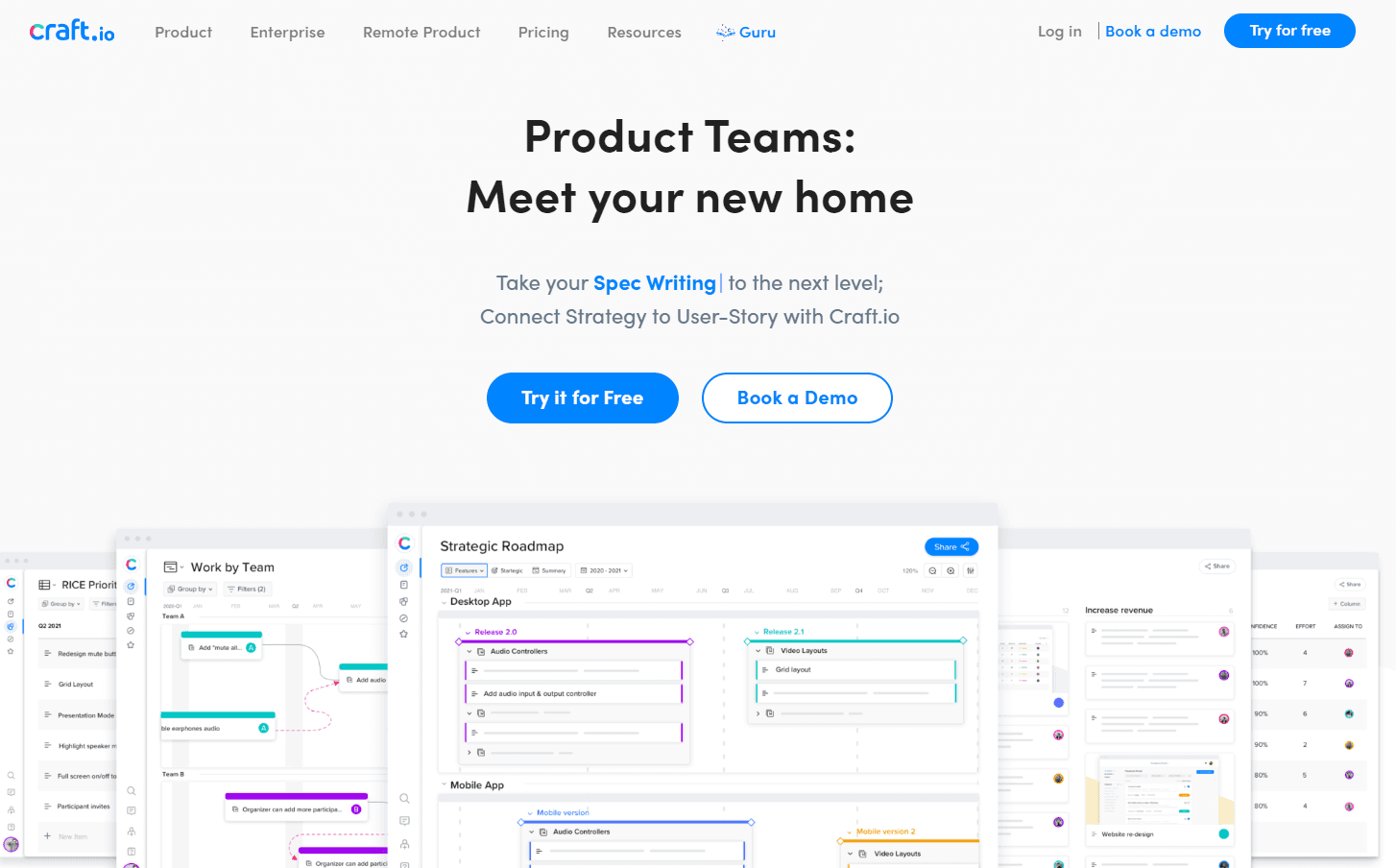
Craft.io is a product management platform that equips teams to manage a product’s lifecycle from a single dashboard. Through its feedback portal, your users can share their experiences, and you can gain insights that lead to data-driven decisions that improve your product.
Features:
Feedback invitation
Roadmap
Centralized portfolio management
Data encryption
Pricing:
Craft.io offers three pricing tiers. Starter is $19 per editor/month and includes one workspace with core backlog and roadmap features. Pro is $79 per editor/month and adds unlimited workspaces, custom fields, integrations, and optional paid add-ons like OKRs, feedback portal, and capacity planning. Enterprise has custom pricing and includes all add-ons and advanced security.
Ratings:
4.5 stars on G2
4.4 stars on Capterra
Pros and cons:
Craft.io is the most execution-focused tool on this list, sitting closest to Productboard and Aha! in scope but with a cleaner interface that earns consistent praise in reviews. Starting at $19/editor/month it’s competitively priced against Productboard at the entry level, though the Pro plan at $79/editor/month narrows that gap. With 79 G2 reviews and a 4.5 rating it’s well-validated for its size. The feedback portal is noted by reviewers as less developed than the roadmapping side, so teams whose primary need is user-facing feedback collection will be better served by Frill. Teams that need deep roadmapping, OKR alignment, and strategy-to-execution visibility will find it one of the strongest options available.
Frequently asked questions
What are the top UserVoice alternatives for startups?
Startups need tools that are affordable, easy to set up, and simple to use. Frill is a strong choice with its clean interface and $25/month entry point. Gleap is another great option, offering visual feedback and bug tracking. Upvoty also fits the bill with plans starting at just $15/month and unlimited users.
What are the top UserVoice alternatives for enterprise companies?
Enterprise companies often need advanced features like SSO, API access, custom workflows, and robust security. Aha! offers modular tools with audit logs, SAML SSO, and Salesforce integration. Pendo includes product analytics, customer sentiment tracking, and onboarding features. Hellonext provides unlimited boards, live chat support, and Salesforce integration on its Business plan.
What are the most affordable UserVoice alternatives?
If you’re looking for budget-friendly alternatives to UserVoice, Frill starts at just $25/month and includes core feedback and roadmap tools. Upvoty is another low-cost option with a $15/month plan that supports unlimited users and boards. Qualaroo also offers a generous free plan with 50 responses and advanced survey features included.
Which UserVoice alternatives offer changelogs, roadmaps, and feedback in one tool?
Several tools provide all three features (changelogs, roadmaps, and feedback), in a single platform. Frill includes all of these on every plan, with a simple UI and affordable pricing. Hellonext also combines feedback boards, a roadmap, and a changelog with built-in moderation. Upvoty offers all three features starting at $15/month.
What features should I look for in a customer feedback tool?
When choosing a customer feedback tool, look for core features like idea collection, voting, and a public roadmap. Changelogs help close the loop with users. Prioritization tools and integrations with tools like Jira or Slack are helpful for workflows. Bonus points for SSO, custom branding, and analytics. The best tools make feedback easy for both teams and users.
Which UserVoice alternative is right for you?
As you can see, there are several alternatives that are more affordable than UserVoice. The best one for your team is the one that matches your budget and offers everything your company needs (typically feedback, roadmaps, and announcements in one place).
Frill is the go-to user feedback tool for several companies because it is affordable, offers all essential features plus user SSO, and has great UX.
Try Frill for yourself and sign up for one of our affordable plans today.

Dayana Mayfield
Dayana Mayfield is a B2B SaaS copywriter who believes in the power of content marketing and a good smoothie. She lives in Northern California.